

The AI governance career path runs from analyst to VP or head of AI governance, and pay rises at each step. The steps are analyst at $132,000, senior individual contributor at $154,000 and manager or lead at $176,000. Above them sit director at $200,000 and VP or head at $225,000. Those are median advertised midpoints from 106 US job postings with stated pay in the AI Training Skool AI Governance Pay Index, collected in October 2026.
Very few people start on the bottom rung. Most move in sideways from GRC, privacy, audit, security, legal, project or data work, and their years in that job count. The detail behind each pay figure, by state, industry and role family, is in the AI Training Skool AI Governance Pay Index. This page covers how to get onto the ladder and how to climb it.
The AI governance career ladder, level by level
An AI governance career has five rungs in the AI Training Skool AI Governance Pay Index (October 2026). What changes as you climb is how much of the program you own, not the type of work. An analyst keeps records for a few AI systems. A lead owns the whole program. A VP answers for it to the board.
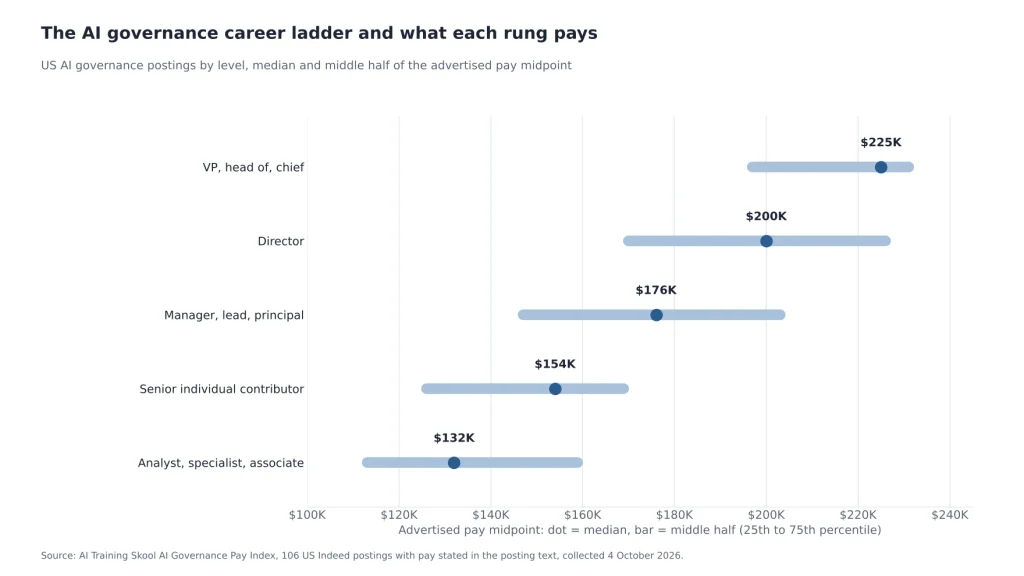
AI governance career ladder pay in the US, October 2026: analyst median $132K, senior individual contributor $154K, manager or lead $176K, director $200K, VP or head $225K, with the middle half of advertised midpoints shown for each level
| Level | Titles seen in US postings | What you own at this level | Evidence that gets you promoted | Median advertised midpoint |
| Analyst, specialist or associate | AI Governance Analyst, GRC Engineer, Privacy and AI Governance Analyst, Technology Auditor, Model Risk Advisor | AI register entries, assessment drafts and evidence collection for assigned systems | Assessments that passed review without rework; a register section you kept current; findings you closed | $132,000 |
| Senior individual contributor | Senior AI Risk Analyst, Sr AI Governance Analyst, Senior GRC Consultant, Sr. AI Governance Architect, Senior Privacy Counsel | One domain end to end, such as third-party AI or one business unit, plus review of junior work | A method other people now use; one scope taken through an internal or external audit | $154,000 |
| Manager, lead, principal or staff | AI Governance Lead, AI Risk and Governance Lead, Security GRC Lead, Manager, AI Assurance and Governance | The AI governance program or AI management system: register, assessments, control decisions, audit cycle, reporting to management | An audit-ready or certified program; a cross-functional committee you run; people or budget you manage | $176,000 |
| Director or associate director | Director, AI Governance; Sr. Director, AI and Technology Risk Governance; Director, AI Regulatory Engagement; IT Audit Director, AI, Cybersecurity and Emerging Technology | AI governance across business units or regions, regulator and customer engagement, risk appetite proposals | Reporting that executives act on; one program covering several frameworks, such as ISO/IEC 42001, the NIST AI RMF and the EU AI Act | $200,000 |
| VP, head, chief or executive director | SVP, Head of AI Governance; Executive Director, AI Risk and Governance; VP, AI Risk Management; Chief Privacy Officer | Accountability to the executive team and board; AI policy; the governance budget | Not a promotion rung: this is where the ladder tops out inside one employer | $225,000 |
Pay: AI Training Skool AI Governance Pay Index, 106 US Indeed postings with pay stated in the posting text. Titles are real postings from the same index of 179 postings. The ownership and evidence columns are AI Training Skool’s reading of what those postings ask for at each level.
At the top rung, some organizations name a chief AI officer. In US federal agencies the post is required. OMB memo M-25-21, issued 3 April 2025, told each agency head to retain or designate a Chief AI Officer within 60 days.
Titles are a poor guide on their own. In the same index, only 44% of postings put “AI” in the job title. The rest were GRC, risk, privacy, audit, data governance or counsel roles with AI governance in the duties.
Where do people enter AI governance from?
People enter AI governance from a neighboring job and bring its evidence with them. The background you start from decides which first role is realistic and which gap you have to close.
| Starting background | What carries over | A realistic first AI governance role | First evidence to build |
| GRC and compliance | Control frameworks, evidence, audit readiness | AI governance analyst or GRC engineer with AI scope | AI systems added to the risk register you already run |
| Privacy | Privacy impact assessments, data mapping, regulator reading | Privacy and AI governance analyst | One AI impact assessment built from a privacy assessment |
| Internal audit | Sampling, testing, objective reporting | Technology auditor covering AI, model risk audit | An audit plan for one AI system |
| Security | Risk assessment, access and logging controls, ISO/IEC 27001 | AI security risk analyst | A map of shared controls between security and AI governance |
| Project management | Delivery plans, owners, deadlines, status reporting | AI governance program manager | A plan to stand up an AI register and review board |
| Legal | Regulatory interpretation, contracts, privilege | Privacy or product counsel with AI scope | A contract clause set for AI suppliers |
| Data and engineering | How models are built, tested and monitored | AI governance engineer or data and AI governance architect | Automated evidence for one control, such as monitoring output |
Source: AI Training Skool analysis, October 2026. First roles are modeled on titles in the AI Governance Pay Index; the other columns are editorial.
From GRC and compliance
GRC is the shortest route in. You already run controls, collect evidence and face audits. In our index, the most common role family for postings naming ISO/IEC 42001 was GRC, compliance and AI governance programs, with a $150,000 median. Start by adding AI systems to the risk work you already own.
From privacy
Privacy professionals already assess how data use affects people, which is close to an AI impact assessment. Privacy program roles in our index had a $147,000 median. The gap is AI system behavior: drift, testing and human oversight. A good first record is one AI impact assessment built from a privacy assessment you already run.
From internal audit
Auditors know how evidence is sampled and judged, which is exactly what a governance program has to survive. Audit and assurance roles had a $150,000 median, though based on fewer than ten postings with pay, so treat it as indicative. The move is from checking controls to building them, and an audit plan for one AI system is a good first record. If you would rather stay on the checking side, read about auditing AI management systems as a career.
From security
Security teams own many of the controls an AI program reuses: access, logging, incident handling and supplier review. If you hold CISM or CISSP, ISACA’s AAISM is open to you as an AI-specific add-on. Before you pitch AI management system work to a security leader, check how ISO/IEC 42001 differs from ISO/IEC 27001 and whether ISO 42001 is mandatory.
From project management
Setting up an AI governance program is a project before it is a routine. Project managers know how to get named owners to deliver by a date. One graduate, Abdulazeez Haroun (Business Analyst, Canada, Trustpilot, August 2026), puts the analyst version well. He says business analysts “can prepare for AI governance by mastering risk frameworks, defining clear evaluation criteria for automated decisions and embedding compliance into project backlogs”. For a project manager, the first evidence is a plan to stand up an AI register and review board.
From legal and privacy counsel
Counsel is the best-paid family on the ladder. Legal and privacy counsel roles covering AI governance had a $225,000 median in our index, against a $159,670 May 2025 median for all lawyers in the BLS Occupational Outlook Handbook. These roles need a law license, so this door is open only to lawyers; others work alongside counsel rather than moving into those roles.
From data and engineering
Engineers bring what most governance teams lack: knowing how a machine learning model is actually built, tested and monitored, usually from data science or software work. Engineering and architecture roles in our index had a $164,000 median, under titles such as AI Governance Engineer and GRC Automation Engineer. In one r/AI_Governance thread asking “Should I move into AI governance”, the top answer pointed to enterprise architecture as the role serious companies look to for this work. The gap for engineers is evidence discipline: writing down who decided what, and when.
Is there such a thing as an entry-level AI governance job?
Entry-level AI governance jobs barely exist. The AI Training Skool AI Governance Pay Index (October 2026) covers 179 US postings. Among them were two internships (one in AI governance, one in model risk) and one junior GRC analyst role. The median posting asked for six years of experience, and five years was the most common ask.
So most people move into AI governance from an existing job rather than starting in it, which is why the first step matters more than the first title. The feeder jobs are open at entry level. The Bureau of Labor Statistics lists a bachelor’s degree and no related work experience as the typical entry route for compliance officers (median pay $80,730, May 2025). For information security analysts, it lists less than five years of related experience ($129,180).
If you have no governance, risk, security or technology background at all, build one first. A feeder role with an entry-level door, such as compliance officer, is the realistic route.
Your first step into AI governance this month
The first step into AI governance is to do one piece of AI governance work inside the job you have now, and keep the record. Reddit threads on this topic keep asking for something concrete, so here it is by situation.
- You work in a company that uses AI tools. List every AI system your team uses, with an owner, purpose and data used for each. Ask each owner to confirm their entry in writing. That is the start of an AI register.
- You already run risk, privacy or audit work. Pick one AI system and run your existing assessment on it, and then note what your method missed: bias, drift, human oversight, supplier model changes.
- You are job hunting. Read ten postings at the level you are aiming for and copy the duties that repeat. Build evidence for those duties, not for the title.
- You have the record. Turn it into a work sample with names and confidential details removed, so you can walk an interviewer through it.
What gets you promoted in AI governance?
Experience, role family and the size of what you own move AI governance professionals up, in that order. In our index, pay jumps at about seven years of experience. Postings asking for up to six years cluster near $147,000, while those asking for seven to nine years sit near $189,000.
Role family matters almost as much as level. Counsel roles ($225,000) and risk and model risk roles ($196,000) pay the most, while GRC programs sit at $150,000. Moving from a GRC program into AI risk work, or adding model risk skills, can be worth more than a new title. A credential on its own does not move pay much, which is what the skeptics get right about ISO 42001 credentials. The IAPP Salary and Jobs Report found the same pattern in a global survey of more than 1,600 professionals in more than 60 countries (published 3 August 2025). In the technology sector, technical AI governance roles had a $221,000 median and legal and compliance roles, $205,000, against $151,800 for respondents working only in AI governance.
Scope is the third lever. At each rung on the ladder you own more: a few systems, then a domain, then the program, then several programs. The proof hiring panels ask for is a record you produced and defended. To see which records a posting implies, read what AI governance job descriptions ask for.
Where AIGP, AAISM and ISO/IEC 42001 Lead Implementer fit on the ladder
AIGP, AAISM and ISO/IEC 42001 Lead Implementer certifications help you qualify for a rung; they do not set your pay. In our index, postings naming ISO/IEC 42001 had a $168,000 median midpoint against $169,000 for those that did not, and postings naming the AIGP had a $156,000 median. Level, role family and experience set pay.
Each credential fits a different point on the path:
- AIGP comes from the IAPP, the International Association of Privacy Professionals, and covers AI governance broadly. It was named in 13% of postings in our index.
- AAISM (ISACA) is for security managers. ISACA requires candidates to hold an active CISM or CISSP, so it suits people already on the security ladder.
- ISO/IEC 42001 Lead Implementer certifies that you can plan, build and run an AI management system, the work a lead or manager owns. ISO/IEC 42001 was named in 40% of postings in our index. To sit the exam, you need at least 32 contact hours of structured ISO/IEC 42001 training.
For a closer look at how the AIGP and the Lead Implementer differ, see the major AI governance credentials compared.
At the manager or lead rung, the job is running the management system. If that is your aim, ISO/IEC 42001 Lead Implementer certification training online from AI Training Skool covers 32 CPD hours across 16 modules. The exam and a retake are included. The training is CPD accredited by the CPD Standards Office (UK). It is not an ISO/IEC 17024 personnel certification. If an employer or regulator requires a 17024-accredited certificate, choose a 17024 scheme instead.
Which AI governance job titles and employers to search
AI governance job searches work best by duty, not only by title, because 56% of the postings in our index had no “AI” in the title at all. Useful duty terms are AI inventory, AI impact assessment, model risk, AI risk, responsible AI and ISO/IEC 42001.
If the role you want is the one that builds the management system, see the records an ISO 42001 Lead Implementer owns and the weekly work behind them. The matching certificate is the Lead Implementer credential for ISO/IEC 42001. For a target list of companies, search the duty terms above and note which employers repeat.
What skills does an AI governance career need?
An AI governance career needs three kinds of skill: risk and evidence method, regulatory reading, and enough technical literacy to question the people who build AI. Employers signal all three in postings. In the AI Training Skool AI Governance Pay Index (October 2026), 40% of postings named the NIST AI Risk Management Framework, 30% named GDPR and 22% named the EU AI Act.
Technical literacy means knowing how a machine learning model is trained, tested and monitored, and what data it uses. Only 18 of the 179 postings in our index sat in engineering and architecture. So for most roles the skill is asking data science teams the right questions and writing down the answers, not building models.
Is AI governance a good long-term career?
AI governance is a good long-term career for people with a related background. The $169,000 median advertised midpoint across our index is more than double the BLS median for compliance officers. AI governance work also spreads across several established occupations rather than resting on one.
Federal data does not yet track AI governance as a job of its own. A search for “AI governance” on O*NET OnLine finds no occupation of that name (October 2026). The nearest established profiles are occupations such as Compliance Managers and Information Security Analysts. O*NET flags Compliance Managers as a Bright Outlook occupation in Job Zone Four (“Considerable Preparation Needed”). BLS projects employment of information security analysts to grow 21% from 2025 to 2035, against 4% for compliance officers.
The main risk is title churn. AI governance work also appears as responsible AI, AI risk, AI assurance and trust roles, and some employers fold it into existing GRC or privacy jobs. Skills tied to records you can show (a register, an assessment, a control decision, an audit) carry across those labels.
Frequently Asked Questions
How do I get a career in AI governance?
Start from the job you have. Most AI governance hires come from GRC, privacy, audit, security, legal, project or data roles. Only three of 179 US postings in our October 2026 index were internships or junior roles. Do one AI governance task at work, such as listing the AI systems your team uses with owners, keep the record, and then apply for roles that list that duty.
Is AI governance lucrative?
Yes, for people with related experience. US AI governance postings had a $169,000 median advertised midpoint in the AI Training Skool Pay Index (106 postings with pay, October 2026). The range ran from $132,000 for analysts to $225,000 for VP and head roles. The BLS median for compliance officers was $80,730 in May 2025.
Can I get an AI governance job with no experience?
Rarely as a first job. The median US posting in our October 2026 index asked for six years of experience, and five years was the most common ask. A realistic route is a feeder role with an entry-level door, such as compliance officer (BLS lists no related experience required), followed by a move into AI governance work from there.
Do you need a law degree or a technical degree for AI governance?
Neither, unless you want a counsel role. Counsel roles paid the most in our October 2026 index ($225,000 median) and require a law license. Most other roles sit in GRC, risk, privacy and audit. In O*NET’s Compliance Managers profile, 63% of respondents said a bachelor’s degree is required, and BLS lists a bachelor’s degree for compliance officers.
Are AI governance jobs remote?
Some are. Remote roles made up 16% of postings in the AI Training Skool Pay Index in October 2026. They had a $166,000 median advertised midpoint, against $169,000 for on-site and hybrid roles. Remote AI governance work therefore pays almost the same, but most roles still expect some time on site.
What does an AI governance engineer do?
An AI governance engineer builds the technical side of the program: automated evidence collection, monitoring of model behavior, access controls and tooling for the AI register. Engineering and architecture roles had a $164,000 median advertised midpoint in our October 2026 index, under titles such as AI Governance Engineer and GRC Automation Engineer.
How long does it take to reach a senior AI governance role?
In our October 2026 index, pay jumped at about seven years of experience, from about $147,000 for postings asking for up to six years to $189,000 for seven to nine years. Years in a related field such as security, privacy, audit or risk count toward those asks, so experienced career movers often enter above the analyst rung.