

An AI governance officer job description asks you to run an organization’s AI risk program: write the policies, assess AI risks and vendors, track new laws and keep the evidence auditors ask for. In 179 US job postings we analyzed (Indeed, 4 October 2026), the median posting asked for six years of experience. Over half (98 of 179, 55%) named the NIST AI RMF, ISO/IEC 42001 or the EU AI Act.
Those 179 postings, from 161 employers and published from 13 July 2026 up to the collection day, are the same set behind the AI Training Skool AI Governance Pay Index. We read every description and counted what each one asks for. The table shows the duties that came up most often.
| Duty named in the posting | Postings | Share of 179 |
| Writing and maintaining policies, standards and procedures | 86 | 48% |
| Supporting audits, collecting evidence, audit readiness | 85 | 47% |
| Generative AI, large language models or AI agents | 83 | 46% |
| Risk assessments (AI, model or enterprise risk) | 82 | 46% |
| Incident response or remediation tracking | 70 | 39% |
| Third-party and vendor risk review, including vendor AI | 58 | 32% |
| Designing, mapping or testing controls | 58 | 32% |
| Supporting an AI governance committee, council or review board | 52 | 29% |
| Reporting metrics to leadership or the board | 40 | 22% |
| Tracking laws, regulations and standards | 39 | 22% |
| Keeping an inventory or register of AI systems and use cases | 30 | 17% |
| Impact assessments (AI, privacy or data protection) | 23 | 13% |
| Training and awareness for staff | 23 | 13% |
| Bias or fairness testing | 22 | 12% |
| Monitoring models or AI systems after deployment | 14 | 8% |
Each posting counts once per duty, from its description text, with recruiting and benefits boilerplate removed. Matching patterns were spot-checked against the matched text in 30 postings. Source: AI Training Skool analysis of 179 US Indeed postings.
What does an AI governance officer do?
An AI governance officer makes sure the AI an organization builds or buys is approved, documented, risk-assessed and monitored, and that the organization can prove it. In the postings, that means three kinds of work: governance paperwork (policies, assessments, registers), coordination (committees, legal, security, data science, vendors) and assurance (controls, evidence, audits).
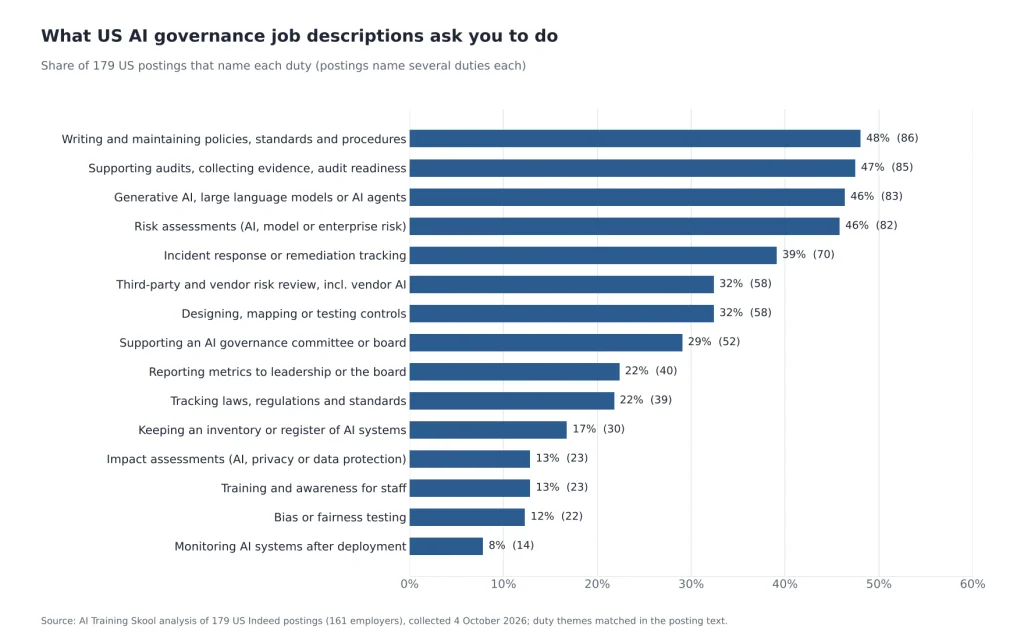
Duties named in 179 US AI governance job postings, October 2026: policies 48%, audits and evidence 47%, generative AI 46%, risk assessments 46%, incident and remediation tracking 39%, vendor risk 32%, controls 32%, governance committee 29%, metrics reporting 22%, regulatory tracking 22%, AI inventory 17%, impact assessments 13%, training 13%, bias testing 12%, post-deployment monitoring 8%
No federal occupation code covers this job yet. A keyword search of O*NET OnLine returns no AI governance occupation, and the closest match is Compliance Managers (11-9199.02), defined as people who “plan, direct, or coordinate activities” to meet ethical or regulatory standards. O*NET lists a 2025 US median of $141,900 for that occupation.
The postings add what O*NET’s compliance description lacks: AI-specific objects and technical partners. Of the 179, 83 (46%) mention generative AI, large language models or AI agents, and 78 (44%) describe the work as cross-functional.
Why do so few postings use the title “AI governance officer”?
“AI governance officer” is a search phrase, not a common job title. Only 1 of the 179 posting titles used the word “officer” at all, and that one was a chief privacy officer role. Employers post this work under other names: 36 of 179 titles (20%) contain “AI governance”, and 44% put “AI” anywhere in the title.
The rest are titled as GRC, risk, privacy, audit, data governance or counsel roles that list AI governance in the duties. Manager, lead, principal and staff roles were the largest group (63 of 179, 35%). Search by duties as well as titles: “AI inventory”, “AI risk assessment” and “responsible AI” find postings a title search misses.
Which title fits you depends on where you start, and the routes from security, privacy, audit and legal are mapped in AI governance career paths by starting background. To find employers that name the standard, search for “ISO 42001” as well as job titles.
The AI governance JD decoder: posting phrases, what they mean and what to show
Each phrase in an AI governance job description maps to work you can do and evidence you can bring to the interview. The table translates the most common phrases from the 179 postings.
| Phrase you will see in postings | What it means day to day | Evidence to show in your application | Postings with this duty |
| Maintain the AI inventory; manage AI use-case intake | Find every AI system and AI feature in bought software, record owner, purpose, data and risk tier, and update it when tools change | A sample register (made up or redacted) with owner, purpose and review-date fields, and a note on how you found unlisted tools | 30 (17%) |
| Conduct AI risk assessments | Score a use case’s risks with a stated method, agree on treatments with the owner, and record who accepted the residual risk | A completed risk assessment with the scale you used, the treatment and a named risk owner | 82 (46%) |
| Perform AI impact assessments, DPIAs or PIAs | Assess the effect of a system on the people it touches, separate from the risk to the company | An impact assessment with affected groups, possible harms, mitigations and an approval date | 23 (13%) |
| Develop AI policies, standards and procedures | Draft an AI policy or acceptable-use standard, get it approved, publish it and track acknowledgement | A policy you drafted, its approval route and its review date | 86 (48%) |
| Assess third-party and vendor AI | Add AI questions to vendor due diligence and decide what happens when a supplier changes its model | A vendor AI questionnaire and one decision record | 58 (32%) |
| Monitor emerging regulations | Read new laws and guidance, decide what changes for your systems, and update the register or policy | A one-page mapping of one law, such as the EU AI Act, to existing controls | 39 (22%) |
| Map controls across frameworks | Keep one control set and show where it meets NIST AI RMF, ISO/IEC 42001, SOC 2 or ISO/IEC 27001 | A crosswalk sheet for five or six controls | 58 (32%) |
| Support the AI governance committee | Prepare submissions, take minutes, track decisions and conditions | A decision log or a committee pack template | 52 (29%) |
| Monitor AI systems after deployment | Collect drift, incident and human-review results at a set frequency and escalate exceptions | A monitoring report that states its frequency and its escalation rule | 14 (8%) |
| Support audits and collect evidence | Answer auditors, index evidence, and close findings at the root cause | An evidence index, or a finding you closed with dates | 85 (47%) |
| Drive AI awareness and training | Run AI literacy or acceptable-use sessions and track completion | A short training deck and the completion figures | 23 (13%) |
| Report risk metrics to leadership | Turn the program into a few indicators executives can act on | A one-page dashboard with three to five risk indicators | 40 (22%) |
Source: AI Training Skool analysis of 179 US Indeed postings, October 2026. The “Day to day” and “evidence” columns are our interpretation of the duty, not posting text.
Hiring managers read the evidence column more closely than the course list on your resume. If you have none of these records yet, build sample versions from public material first. For how these records fit into a running AI management system under ISO/IEC 42001, see the job behind the ISO 42001 Lead Implementer certificate.
How much experience do AI governance job descriptions require?
Most AI governance job descriptions ask for five years of experience or more. Of the 146 postings that state a minimum, the median ask was six years and the most common single ask was five years (31 postings).
| Minimum experience asked for | Postings | Share of 179 |
| 0 to 3 years | 27 | 15% |
| 4 to 6 years | 50 | 28% |
| 7 to 9 years | 30 | 17% |
| 10 years or more | 39 | 22% |
| No years stated | 33 | 18% |
The minimum is the smallest number of years the posting names. Source: AI Training Skool analysis, 179 US Indeed postings, October 2026.
Those years rarely have to be in AI governance itself. The postings ask for experience in GRC, privacy, security, risk, audit or legal work and then list AI duties on top. If your background is in a neighboring field, count those years before you rule a posting out.
Degrees matter less than years. A bachelor’s degree was named in 91 of 179 postings (51%), and 60 (34%) accepted equivalent experience in place of a degree or said “or equivalent”. A master’s degree or MBA appeared in 36 (20%) and a J.D. or law degree in 21 (12%), mostly in counsel and legal roles. The most frequently named field was computer science, information systems or IT (62 postings, 35%).
Which frameworks and laws do AI governance postings name?
The NIST AI Risk Management Framework and ISO/IEC 42001 are the two most frequently named frameworks, each in 71 of 179 postings (40%). Privacy and security frameworks follow, because most AI governance roles sit inside an existing GRC or privacy program.
| Framework or law | Postings | Share of 179 |
| NIST AI Risk Management Framework | 71 | 40% |
| ISO/IEC 42001 | 71 | 40% |
| GDPR | 54 | 30% |
| ISO/IEC 27001 | 48 | 27% |
| EU AI Act | 40 | 22% |
| SOC 2 | 40 | 22% |
| HIPAA | 32 | 18% |
| CCPA or CPRA | 31 | 17% |
| NIST Cybersecurity Framework | 26 | 15% |
Source: AI Training Skool analysis, 179 US Indeed postings, October 2026. One of the two searches behind the sample was “ISO 42001”, so the ISO/IEC 42001 share runs higher than in the wider market.
The NIST AI Risk Management Framework, released 26 January 2023, is “intended for voluntary use”. Its four functions (Govern, Map, Measure, Manage) give many US employers their working vocabulary. The EU AI Act reaches US employers that sell into the EU. According to the European Commission AI regulatory framework page, the Act generally applies from 2 August 2026. The AI Omnibus moved the high-risk rules to 2 December 2027 and 2 August 2028.
When a posting says “experience with NIST AI RMF, ISO/IEC 42001 or similar”, it wants someone who can turn a framework into records and controls, not someone who can recite it.
Which certifications do AI governance job descriptions ask for?
Certifications are usually a preference, not a requirement. Of the 179 postings, 79 (44%) named at least one certification. Of those 79, 35 put it in a sentence with “preferred”, “a plus” or similar wording, and only 3 used “required” wording.
| Certification named | Postings | Share of 179 |
| CISSP | 48 | 27% |
| CISA | 41 | 23% |
| CRISC | 36 | 20% |
| CISM | 35 | 20% |
| CIPP (any) | 35 | 20% |
| AIGP | 24 | 13% |
| CIPM | 19 | 11% |
| ISO/IEC 27001 Lead Auditor or Lead Implementer | 6 | 3% |
| ISO/IEC 42001 Lead Auditor or Lead Implementer | 3 | 2% |
Source: AI Training Skool analysis, 179 US Indeed postings, October 2026.
Two patterns stand out. Security and audit credentials (CISSP, CISA, CRISC, CISM) lead because many of these roles sit in security GRC. And employers name the ISO/IEC 42001 standard far more often (40%) than any ISO/IEC 42001 credential (2%): they want the skill of building the system, and a credential is one way to show it. If you are weighing the two AI-specific options, read about choosing between AIGP and ISO 42001 Lead Implementer, which compares what each one certifies. Because so few postings name the credential itself, check who ISO 42001 Lead Implementer is not worth it for before you pay for one. The Lead Auditor variants in the table point to a different job, checking an AI management system rather than building it; see what ISO/IEC 42006 expects of AIMS auditors.
What tools and reporting lines do AI governance postings list?
Most AI governance postings name few specific tools. Cloud platforms (AWS, Azure or Google Cloud) led, appearing in 35 of 179 postings (20%). GRC platforms followed (21, 12%), then ServiceNow (20, 11%), Python (19, 11%) and Power BI or Tableau (19, 11%). OneTrust and Collibra appeared in 10 postings each (6%).
Only 32 of 179 postings (18%) said who the role reports to. Where they did, the most common lines were a security leader such as the CISO (7) and a legal leader such as the general counsel (6). AI leaders and risk or audit leaders followed with 4 each. Technology, privacy, compliance and unnamed managers made up the rest. Ask about the reporting line in the first interview: it tells you whether the program is run as security, legal or data work.
What does an AI governance officer earn by level?
AI governance pay rises with level, from a $132,000 median midpoint for analyst roles to $225,000 for VP and head-of roles. The median across all 106 postings that state pay is $169,000 (Pay Index, October 2026), and pay jumps most at about seven years of experience. The Pay Index also breaks down AI governance pay by experience, role family and state.
AI governance officer job description template
The template below is built from the duties and requirements that appeared most often in the 179 postings. It is a template, not a real posting. Hiring managers can adapt it, and job seekers can use it as a checklist.
Template: AI Governance Manager (also posted as AI Governance Lead or AI Risk and Governance Lead)
About the role. You will run our AI governance program so that every AI system we build or buy is approved, documented, risk-assessed and monitored. You will work with legal, security, privacy, data science, product and procurement. Reports to: [CISO, general counsel or chief data and AI officer].
What you will do
- Write and maintain the AI policy, acceptable-use standard and supporting procedures, and track acknowledgement.
- Run AI risk assessments for new and changed use cases, and agree on treatments with system owners.
- Review third-party and vendor AI, including AI features added to software we already license.
- Maintain the inventory of AI systems and use cases, with owners, purposes and risk tiers.
- Run impact assessments for systems that affect customers, employees or the public.
- Map our controls to the NIST AI RMF, ISO/IEC 42001 and applicable laws such as the EU AI Act, and keep evidence ready for audits.
- Track new AI laws, regulations and standards, and update policies and controls when they change.
- Prepare submissions and decision records for the AI governance committee, and report risk metrics to leadership.
- Deliver AI awareness training to staff.
What you will bring
- Five or more years in governance, risk and compliance, privacy, security, audit or legal work.
- Working knowledge of the NIST AI RMF and ISO/IEC 42001, and of GDPR or US privacy law.
- Experience writing policies and running risk or impact assessments.
- Bachelor’s degree in computer science, information systems or a related field, or equivalent experience.
Preferred
- A certification such as CISSP, CISA, CRISC, CISM, CIPP or AIGP.
- Experience with a GRC platform, and enough Python or SQL to read model and data documentation.
- Experience with generative AI or large language model deployments.
Pay and location. [Advertised pay range.] [Remote, hybrid or on-site.]
Frequently Asked Questions
What is an AI governance officer?
An AI governance officer is the person who makes sure an organization’s AI systems are approved, documented, risk-assessed and monitored. In 179 US job postings collected in October 2026, the most frequently named duties were policies (48%), audits and evidence (47%) and risk assessments (46%). Only one posting title used the word “officer”, so the work is usually posted as an AI governance manager, lead or analyst role.
What are the responsibilities of an AI governance officer?
The responsibilities of an AI governance officer are writing AI policies, assessing AI and vendor risks, tracking laws such as the EU AI Act, supporting a governance committee and keeping audit evidence. In our October 2026 sample of 179 US postings, 46% named risk assessments, 32% vendor risk review and 22% regulatory tracking. Only 17% asked for an inventory of AI systems.
What qualifications do you need for an AI governance job?
Most US AI governance postings ask for five or more years of experience in GRC, privacy, security, risk, audit or legal work. The median minimum was six years across 146 postings that state one (October 2026). A bachelor’s degree appeared in 51% of 179 postings, and 34% accepted equivalent experience instead.
Do AI governance jobs require a certification?
Rarely. Of 179 US AI governance postings collected in October 2026, 44% named any certification, and only 3 postings used “required” wording for it. CISSP (27%), CISA (23%), CRISC and CISM (20% each) were named most often. AIGP appeared in 13% of postings and an ISO/IEC 42001 credential in 2%.
Who does an AI governance officer report to?
An AI governance officer most often reports to a security or legal leader. Of 179 US AI governance postings collected in October 2026, only 32 named a reporting line. Among those, 7 reported to a security leader such as the CISO and 6 to a legal leader such as the general counsel. AI leaders and risk or audit leaders had 4 each.
Is there an AI governance officer job description template or PDF?
Yes. The template on this page is built from the duties and requirements named most often in 179 US AI governance postings collected in October 2026. It is a template, not a real posting. Hiring managers can copy it into their own document and adjust the reporting line, pay range and location fields. Job seekers can use the duty list as a checklist of evidence to prepare.
How we analyzed the postings
We used the 179 US postings in the AI Training Skool AI Governance Pay Index, collected from Indeed on 4 October 2026 with two searches, “AI governance” and “ISO 42001”. The index keeps governance, risk, compliance, privacy, audit, data governance and legal roles that mention AI governance or ISO/IEC 42001. The postings come from 161 employers and were published between 13 July 2026 and the collection day.
For each posting we searched the full description text for duty phrases, frameworks, certifications, degrees, tools and reporting lines, and counted each posting once per item. Recruiting, benefits and equal opportunity boilerplate was removed before counting duties. Years of experience are the smallest number of years named in the posting.
Limits: one job board, one collection day and pattern matching on English text, so some duties described in unusual wording are missed. In a second check we read the matched text in 30 postings and narrowed patterns that caught unrelated wording, such as company descriptions or benefits text, so the duty counts lean conservative. Duty labels and the evidence column of the decoder are our interpretation. We will refresh the analysis with the Pay Index each quarter.