
In our worked example for a fictional 200-person US SaaS company, the certification body’s fee is a small part of what ISO/IEC 42001 certification costs: audit fees make up $25,000 of a $229,359 three-year total (10.9%). Internal staff time is 76.9%. The standard itself is a minor line: CHF 225 on ISO/IEC 42001:2023 on iso.org.
Every figure in the example below is an assumption, shown so you can replace it with your own numbers. It is an example, not a quote. If you are pricing training for yourself rather than certification for a company, see the ISO 42001 Lead Implementer fee breakdown instead.
The Cost Lines in an ISO 42001 Certification Budget
An ISO/IEC 42001 certification budget has nine cost lines. Six are paid to outside parties, two come from your own payroll, and the gap analysis can be either.
| Cost line | What drives it | Who you pay | One-off or recurring | Verified price or basis |
| The standard | Number of licensed copies | ISO or a national body | One-off | CHF 225 (iso.org); US$369, or US$295.20 for ANSI members (ANSI Webstore); US$256.80 for the identical INCITS adoption |
| Implementer training | Number of people trained | Training provider | One-off, plus renewal | US$795 per seat for our course |
| Gap analysis | Scope size, adviser or in-house | Adviser or your team | One-off | Your quote or your hours |
| Internal staff time | AI systems in scope, existing management systems | Your payroll | Both | Hours × your loaded rate |
| Tooling | Spreadsheets or a GRC platform | Software vendor | Recurring | Your subscription |
| Certification body, Stage 1 and Stage 2 | Audit time × day rate, plus travel | Certification body | One-off per cycle | Certification body quote |
| Surveillance audits | Audit time | Certification body | Yearly | Certification body quote |
| Recertification audit | Audit time | Certification body | Every three years | Certification body quote |
| Corrective action | Number and grade of findings | Your payroll | Both | Hours × your loaded rate |
Sources: iso.org, ANSI Webstore (ISO/IEC 42001:2023 and INCITS/ISO/IEC 42001:2023 (2024)), AI Training Skool course price, October 2026.
Buy the standard once per person who needs it, under its license terms. The cheapest US copy we found was the INCITS identical national adoption at US$256.80 on the ANSI Webstore, against US$369.00 for the ISO/IEC edition on the ANSI Webstore ISO/IEC 42001 listing.
Some spending sits outside the certification budget even when it happens in the same year. Building or fixing AI features, and legal work for a specific law such as the EU AI Act, would be needed with or without a certificate, so keep them out of the model.
What Certification Body Fees Depend On
Certification body fees depend mainly on audit time: the number of auditor days needed for your scope, multiplied by the body’s day rate, plus travel and administration. Larger scopes, more AI systems and more sites mean more audit days. Audit time for an AI management system is set by a standard, not by negotiation alone.
ISO/IEC 42006:2025 sets the additional requirements for bodies that audit and certify AI management systems, building on ISO/IEC 17021-1. Its draft (FDIS) text has a subclause on determining audit time (9.1.4), a normative Annex A on audit time and an informative Annex B with example calculations. The preview does not include the Annex A tables, so we do not quote day counts here. Ask each certification body to show how it applied Annex A to your scope. For the rest of the rules, see what ISO/IEC 42006 requires of certification bodies.
The FDIS preview has other subclauses that move audit time and cost. Multi-site sampling (9.1.5) covers scopes with several sites, and 9.1.6 covers auditing other management systems at the same time. Remote audit (9.2.4) can cut travel.
After the first year, audit time falls. IAF MD 5 puts yearly surveillance at about one third of initial audit time and recertification at about two thirds. MD 5 covers quality, environmental and health and safety systems, not AI, so we use those ratios only as a budgeting assumption.
Accredited vs Non-Accredited Certification: Price and Recognition
An accredited certificate can cost more, but it is the one most buyers accept. Accreditation means an accreditation body has assessed the certification body itself.
In the US, ANSI National Accreditation Board accredits AIMS certification bodies. The ANAB AIMS accreditation program post states that ANAB “launched the ISO/IEC 42001 Artificial Intelligence Management Systems (AIMS) program in January 2024.” Accredited bodies carry the cost of accreditation assessments and of auditors who meet ISO/IEC 42006 competence rules, which is one reason their quotes differ from unaccredited ones.
A cheaper unaccredited certificate can fail the test that made you certify in the first place: a customer’s procurement team rejects it. Before you compare quotes, read how ISO 42001 certification is accredited and confirm each candidate holds ISO/IEC 42001 on its accreditation scope.
Internal Costs: Gap Analysis, Staff Time, Tooling and Training
Internal costs are the largest share of the budget because the standard asks your people to build and run a management system. They are also the costs most published estimates leave vague.
- Gap analysis. An adviser’s fixed fee or your own hours, comparing current practice with clauses 4 to 10 and the Annex A controls. The output is the project plan that sets every other internal cost.
- Staff time. The AIMS lead’s hours, plus engineering, data, legal, product and security experts who run risk and impact assessments (clauses 8.2 to 8.4), and leadership time for the AI policy and management review (5.2, 9.3).
- Internal audit. Clause 9.2 requires an internal audit program, run by auditors who are objective about the work they check.
- Tooling. A spreadsheet-based AIMS is possible. A GRC platform module adds a subscription but can save evidence-collection hours.
- Training. At least one person needs to know the standard well enough to lead the work and face the auditor.
- Corrective action. Findings from internal audit, Stage 1 and Stage 2 all take hours to fix and evidence.
Worked Example: A 200-Person US SaaS Company
The example company is fictional: 200 employees, four AI features of its product in scope, no existing ISO certificate, remote audits. We price internal time at an assumed loaded rate of $100 an hour. Replace each assumption with your own.
Year 1 (example, not a quote)
| Cost line | Assumption | Cost |
| The standard | One ISO/IEC 42001 PDF from the ANSI Webstore at list price | $369 |
| Implementer training | Two seats at US$795 (the AIMS lead and a backup lead from engineering, so the work survives one departure) | $1,590 |
| Gap analysis | Adviser’s fixed fee (assumed) | $8,000 |
| Internal staff time | 892 hours × $100: AIMS lead 500, subject experts 250, leadership 30, internal audit 40, management review 12, corrective action 60 | $89,200 |
| Tooling | GRC module subscription (assumed) | $6,000 |
| Certification body, Stage 1 and Stage 2 | Assumed quote, remote, no travel | $15,000 |
| Year 1 total | $369 + $1,590 + $8,000 + $89,200 + $6,000 + $15,000 | $120,159 |
Years 2 and 3, each (example)
| Cost line | Assumption | Cost |
| Internal staff time | 436 hours × $100: AIMS upkeep 300, assessments for new or changed AI systems 60, internal audit 40, management review 12, corrective action 24 | $43,600 |
| Tooling | Same subscription | $6,000 |
| Surveillance audit | One third of the initial fee, the IAF MD 5 ratio used as an assumption | $5,000 |
| Yearly total | $43,600 + $6,000 + $5,000 | $54,600 |
Example only. All figures are assumptions except the standard and training prices, which were checked in October 2026.
The three-year total is $120,159 + $54,600 + $54,600 = $229,359. Certification body fees are $15,000 + $5,000 + $5,000 = $25,000, or 10.9% of the total. Internal staff time is $89,200 + $43,600 + $43,600 = $176,400, or 76.9%.
The recertification audit falls due before the certificate expires and opens the next cycle. Assuming an unchanged scope, two thirds of the initial fee gives $10,000 for that audit, plus your preparation hours.
How an Existing ISO/IEC 27001 Program Lowers the Cost
A company that already runs an ISO/IEC 27001 information security management system can expect a lower ISO/IEC 42001 cost, because both standards share the same clause structure. The official preview of ISO/IEC 42001 says it applies the harmonized structure, with “identical clause numbers, clause titles, text and common terms” across management system standards.
That shared skeleton means document control, internal audit, management review and corrective action can be extended rather than built. What stays new is the AI work: the AI system inventory, the AI policy, AI roles, AI risk and impact assessments and the AI controls in the Statement of Applicability. For how the two fit together in detail, see how ISO 42001 and ISO 27001 fit together.
Here is the same fictional company with an ISO/IEC 27001 certificate already in place. Every change is an assumption.
| Cost line | Without 27001 (Year 1) | With 27001 (Year 1) | Assumption behind the change |
| Standard and training | $1,959 | $1,959 | No change |
| Gap analysis | $8,000 | $5,000 | Smaller gap |
| Internal staff time | $89,200 (892 hours) | $61,000 (610 hours) | AIMS lead 320, experts 200, leadership 20, extra internal audit 24, extra review 6, corrective action 40 |
| Tooling | $6,000 | $2,000 | Extend the existing GRC platform |
| Certification body, initial | $15,000 | $12,000 | Combined audit covers shared clauses once |
| Year 1 | $120,159 | $81,959 | |
| Years 2 and 3, each | $54,600 | $37,000 | 310 hours ($31,000), $2,000 tooling, $4,000 surveillance |
| Three-year total | $229,359 | $155,959 | $81,959 + $37,000 + $37,000 |
Example only. Not a quote.
In this example, the existing ISO/IEC 27001 program saves $73,400 over three years, or 32%. Ask your current certification body whether it can audit both systems together; ISO/IEC 42006 has a subclause on multiple management systems (9.1.6), and an integrated audit is where most of the fee saving comes from.
The Three-Year Total Cost of Ownership
Budget ISO/IEC 42001 certification as a three-year cycle, not a one-time purchase. Total cost of ownership counts every direct and indirect cost of owning something over its life, and the certificate is a good fit for that view.
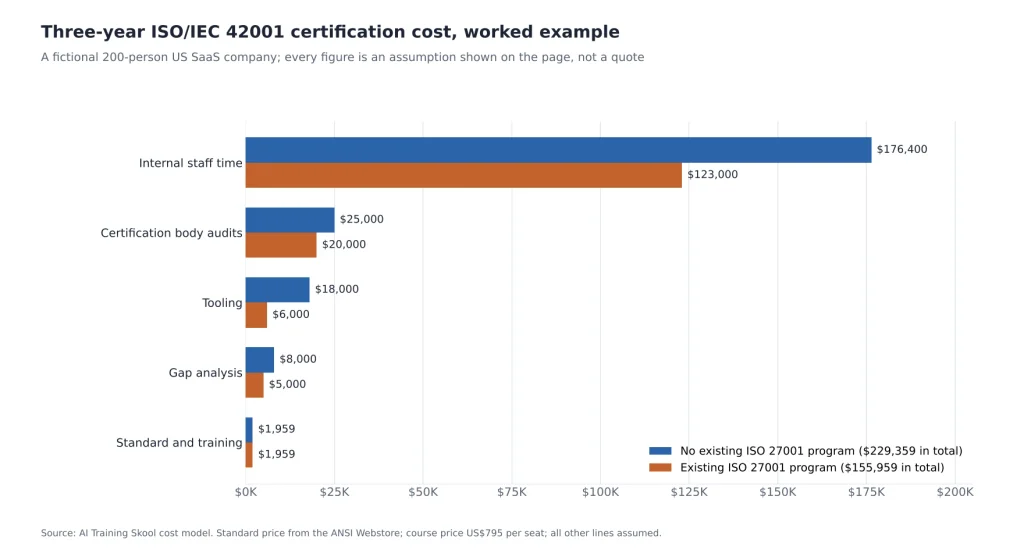
Three-year ISO/IEC 42001 certification cost for a fictional 200-person US SaaS company: $229,359 without an existing ISO 27001 program and $155,959 with one; internal staff time $176,400 vs $123,000, certification body audits $25,000 vs $20,000, tooling $18,000 vs $6,000, gap analysis $8,000 vs $5,000, standard and training $1,959 in both
A certificate runs on a three-year cycle: initial audit, surveillance at least once a calendar year, and recertification before expiry. Years 2 and 3 cost less than year 1 in our example, but they are not small: $54,600 each without ISO/IEC 27001. Stop funding the upkeep and the AIMS falls behind, and surveillance audits find it. For the audit sequence behind these costs, see ISO 42001 certification for a company, step by step.
Why Published ISO 42001 Cost Estimates Differ
Published estimates differ because they count different things. Most give a range for audit fees and a loose figure for “implementation”, and few price internal hours line by line.
A US compliance-software vendor’s guide that we opened in October 2026 puts the initial certification audit at $5,000 to $20,000 in one place and $7,000 to $20,000 in another, and surveillance audits at $3,500 to $9,000. The same guide puts total initial cost at “several thousand dollars to $75,000+”. A UK compliance-software vendor quotes £8,000 to £50,000 or more. When one guide gives two audit-fee ranges, treat any single range with care.
Our example’s audit fees sit inside those published ranges. The total is higher because it prices 892 hours of internal time in year 1 instead of leaving staff time out.
How to Lower the Cost Without Weakening the Audit
The biggest savings come from scope, reuse and in-house skill, not from a cheaper auditor.
- Start with a focused scope. Certify one product line or business unit first, stated plainly in the clause 4.3 scope, then extend it.
- Reuse what you have. Extend existing ISO/IEC 27001 or ISO 9001 processes for document control, internal audit, management review and corrective action.
- Run internal audit and management review before Stage 1. Findings you fix yourself cost hours; findings a certification body raises cost hours plus a follow-up.
- Ask for remote audit time where the certification body’s rules allow it, to cut travel.
- Build skill in-house. Paying an adviser for every step is the most expensive route over three years, because upkeep never stops.
For the fifth point, ISO/IEC 42001 Lead Implementer training for in-house implementation costs US$795 per person and covers clauses 4 to 10, Annex A and the core records through a case study workbook. In the example above, two seats are $1,590, under 1% of the three-year total.
Is ISO 42001 Certification Worth the Cost?
ISO/IEC 42001 certification is worth the cost when a customer, contract or tender asks for it, or when your AI products sell into buyers who score third-party assurance. It is harder to justify for a company with a few internal AI tools and no outside demand, which can adopt the standard without certifying.
Look at who already holds certificates in your market. If your competitors and suppliers are certifying, buyers will start asking you too. Our list of US companies with ISO 42001 certificates shows who is ahead.
Frequently Asked Questions
How Much Does ISO 42001 Certification Cost a Company?
It depends on scope and on what you already have. In our worked example for a fictional 200-person US SaaS company with no ISO certificate, year 1 costs $120,159 and the three-year cycle $229,359, of which certification body fees are $25,000. With an existing ISO/IEC 27001 program, the same example falls to $155,959 over three years. These are assumptions, not quotes.
How Much Do ISO 42001 Surveillance Audits Cost?
Surveillance fees depend on audit time, which certification bodies set under ISO/IEC 42006 Annex A. As a budgeting assumption, IAF MD 5 puts yearly surveillance at about one third of initial audit time for quality, environmental and safety systems. On a $15,000 initial audit fee, that suggests about $5,000 a year. One vendor guide we opened quoted $3,500 to $9,000.
How Much Does the ISO/IEC 42001 Standard Cost?
ISO sells ISO/IEC 42001:2023 for CHF 225 on iso.org. In the US, the ANSI Webstore lists the ISO/IEC PDF at US$369.00, or US$295.20 for ANSI members, and the identical INCITS national adoption at US$256.80, as of October 2026. Buying the standard is optional for learning it but needed in practice for implementation.
Does ISO 27001 Reduce the Cost of ISO 42001 Certification?
Usually, yes. Both standards use ISO’s harmonized structure, so document control, internal audit, management review and corrective action can be extended rather than rebuilt, and a certification body may audit both systems together. In our labeled example, an existing ISO/IEC 27001 program cuts the three-year cost from $229,359 to $155,959, a 32% saving.
Do You Pay Again for ISO 42001 Recertification?
Yes. A certificate runs on a three-year cycle, and a recertification audit must be completed before the certificate expires. IAF MD 5, written for quality, environmental and safety systems, puts recertification at about two thirds of initial audit time. On a $15,000 initial fee, that assumption gives about $10,000, plus your preparation hours.