

An ISO 42001 Lead Implementer plans, leads and oversees the implementation of an Artificial Intelligence Management System (AIMS) under ISO/IEC 42001:2023. The implementer then keeps the AIMS running until certification and after it. Day to day, the job is producing the records an auditor reads and keeping them current as AI systems change.
ISO/IEC 42001:2023 on iso.org, published 18 December 2023, sets requirements for “establishing, implementing, maintaining, and continually improving” an AIMS. The Lead Implementer is the person who turns those requirements into a working system. That system has a register of AI systems, a policy, assessments, decisions about controls, audits and reviews. Each has a named owner and a date. Organizations that want certification, or that face AI questions from customers and stakeholders, need someone in that seat.
The records an ISO 42001 Lead Implementer owns, clause by clause
A Lead Implementer owns the process behind about a dozen core records. There is at least one for each clause from 4 to 10, plus the Statement of Applicability for Annex A. The implementer drafts or maintains most of them. Other people sign most of them. For the clause 5 record, what clause 5.2 asks an AI policy to contain walks through a policy you can evidence.
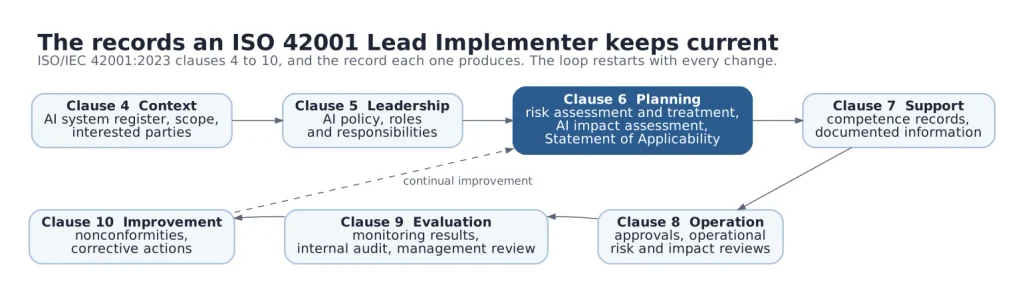
The records an ISO 42001 Lead Implementer keeps current, by ISO/IEC 42001:2023 clause: clause 4 AI system register and scope, clause 5 AI policy and roles, clause 6 risk assessment, AI impact assessment and Statement of Applicability, clause 7 competence records, clause 8 approvals and operational reviews, clause 9 monitoring, internal audit and management review, clause 10 nonconformities and corrective actions
| Clause | Record the implementer produces | What it proves | Who usually signs it | How often it is reviewed |
| 4, Context | AIMS scope statement, interested parties and their requirements, and AI system register | Which AI systems are in scope, with an owner and purpose for each | Top management approves the scope; system owners confirm their entries | When a system is added, changed or retired, plus a planned review |
| 5, Leadership | AI policy, and roles and responsibilities | Top management has set direction and assigned authority | Top management | At planned intervals the organization sets |
| 6, Planning | AI risk assessment, risk register and risk treatment plan | Risks are identified, rated and treated by a stated method | Management approves the treatment plan; risk owners accept residual risk | At planned intervals and when significant changes are proposed or occur (clause 8.2) |
| 6, Planning | AI system impact assessment, using ISO/IEC 42005 as guidance | Effects on individuals, groups and society were assessed before deployment | The system owner and the approver named in the procedure | At planned intervals and when significant changes are proposed or occur (clause 8.4) |
| 6, Planning (Annex A) | Statement of Applicability | Every Annex A control is applied or excluded, with a justification | Management | Whenever the risk treatment changes |
| 6, Planning | AI objectives and plans to reach them | The AIMS has measurable targets | Top management | At planned intervals |
| 7, Support | Competence records and awareness evidence | People doing AIMS work are competent, with evidence | Line managers or HR; the implementer checks coverage | When roles change or training is completed |
| 8, Operation | Operational approvals: deployment, access, tool, change and supplier decisions | Each decision shows who decided and what was in front of them | The system owner or approver named in the procedure | Per decision |
| 9, Performance evaluation | Monitoring and measurement results | The AIMS is checked at a stated frequency, nil returns included | Process owners report; the implementer compiles | At the frequency the organization sets |
| 9, Performance evaluation | Internal audit program and audit reports | The AIMS conforms and is effective, checked by objective auditors | Management approves the program; auditors sign reports | At planned intervals (no frequency is set in the standard) |
| 9, Performance evaluation | Management review minutes and decisions | Top management reviewed the AIMS and decided on changes | Top management | At planned intervals |
| 10, Improvement | Nonconformity and corrective action log, plus continual improvement actions | Problems were fixed at the cause, with dates, and not backdated | Action owners close actions; the implementer verifies effectiveness | Per nonconformity, then at management review |
Source: AI Training Skool records map, built on the ISO/IEC 42001:2023 clause structure (clauses 4 to 10 and Annex A). Clause titles checked against published clause summaries. “Planned intervals” is the standard’s own wording; it lets the organization set the frequency. The sign-off column shows common practice, not wording from the standard.
The table is the job description most course pages never print. Each row is a separate piece of work with its own method. The impact assessment row has no ISO/IEC 27001 equivalent. That is because the AI system impact assessment under clause 6.1.4 looks at effects on individuals, groups and society, not risk to the organization. The order you build the records in is a project plan of its own, set out in how to implement ISO 42001, clause by clause.
Does a Lead Implementer approve risks and controls?
An ISO 42001 Lead Implementer mostly does not approve risks or controls. The implementer prepares, evidences and records decisions, and then hands each one to the person entitled to make it.
A risk owner accepts residual risk, scored under the ISO 42001 AI risk assessment method the organization has adopted. Management approves the risk treatment plan and the Statement of Applicability, including the exclusions covered in ISO 42001 Statement of Applicability decisions and justifications. The system owner decides whether an AI system goes into production. Top management owns the AI policy and the outputs of management review. The one place the implementer usually signs is verifying that someone else’s corrective action closed and worked.
Put that split in writing on day one. An implementer held accountable for decisions they cannot approve is set up to fail. The failure tends to show up at an audit as a risk treatment nobody with authority signed.
A Lead Implementer’s week, during implementation and after
A Lead Implementer’s week depends on the phase. During implementation the week is build work: finding AI systems, drafting records and getting first approvals. Once the AIMS is running, the week turns into a cycle of intake, upkeep and evidence. The patterns below describe typical work, not a diary of any one person.
A typical Lead Implementer week during implementation
| Part of the week | Work | Records touched |
| Discovery | Interview business units; check procurement records, expense claims and single sign-on logs for AI tools nobody declared | AI system register |
| Drafting | Write or revise the scope, AI policy and risk method; hold drafting sessions with legal and data science | Scope, policy, risk method |
| Assessment | Run risk and impact assessments for the first in-scope systems with their owners | Risk register, impact assessments |
| Control decisions | Map treatments to Annex A; draft exclusion justifications | Statement of Applicability |
| Approvals | Take finished drafts to the approver; log decisions and dates | Approval records |
| Planning | Update the project plan, gaps and owners for top management | Project tracker, objectives |
Typical pattern before the Stage 1 audit. Source: AI Training Skool, from the ISO/IEC 42001 clause sequence, October 2026.
Implementation ends in a dress rehearsal: an internal audit of the new system, then a management review, before the certification body’s Stage 1 audit. Whoever runs that audit should not be the person who built the process, which is the point of independence between ISO 42001 implementers and auditors. Expect each record to go through more than one draft. A register usually grows during discovery, then shrinks when duplicates and retired tools are removed. The fields and the discovery sources are covered in building the AI system register ISO 42001 expects.
A typical Lead Implementer week once the AIMS is running
| Part of the week | Work | Records touched |
| Intake | Triage new or changed AI systems: in scope or not, possible effect on people, existing control or a new one | Register, impact assessment trigger |
| Upkeep | Reconcile register entries: same purpose, owner and model version, or retired | Register, Statement of Applicability |
| Evidence | Collect monitoring output from process owners, including nil returns | Monitoring results |
| Follow-up | Chase open corrective actions and verify closed ones | Corrective action log |
| Audit cycle | Scope the next internal audit, or respond to findings from the last | Internal audit program |
| Watch | Read vendor release notes and regulatory updates, such as EU AI Act guidance or NIST AI RMF profiles; decide whether any register entry changed | Register, risk register |
Typical steady-state pattern. Weekly, monthly and quarterly cadences are working conventions, not requirements of ISO/IEC 42001. Source: AI Training Skool, October 2026.
When in doubt, escalate items in the intake queue. A system wrongly set aside can turn up later as an unassessed AI system inside the scope. That is a nonconformity. A system wrongly escalated costs a few hours. Watch for three changes that never arrive as a request. The first is a vendor adding an AI feature to a tool you already license. The second is a business unit using an approved system for a new purpose. The third is a model version upgrade.
Who does an ISO 42001 Lead Implementer work with?
A Lead Implementer works with almost every function that buys, builds or signs off AI, and with one outside party, the certification body.
| Who | What the implementer needs from them | What they get from the implementer |
| Top management | Scope approval, the AI policy, resources, management review decisions | A short pack: status, risks, objectives, audit results |
| Legal and privacy | Regulatory reading, contract terms, privacy assessments to reuse | Impact assessment drafts, records for regulators and customers |
| Data science and engineering | System descriptions, data sources, testing and monitoring output | A clear list of what evidence each system needs |
| Security | Access control, logging, incident handling, the ISO/IEC 27001 controls already in place | Mapping so shared controls are evidenced once |
| Procurement | Supplier lists and new AI purchases | Supplier questions and approval criteria |
| Internal audit | An objective audit of the AIMS at planned intervals | The audit program scope and the records to sample |
| Certification body | Stage 1 and Stage 2 audits, then surveillance | Access to records, people and corrective action evidence |
Source: AI Training Skool, October 2026.
Two of those relationships have rules attached. Internal auditors must be objective, so the implementer who built a process should not audit it. An accredited certification body cannot help you build the system it certifies. ISO/IEC 17021-1 clause 5.2.5 says a certification body “shall not offer or provide management system consultancy”. The European co-operation for Accreditation confirms this in its published guidance. ISO/IEC 42006:2025, published July 2025, builds on ISO/IEC 17021-1 with AI-specific requirements. The goal is for certification bodies to have the competence to assess an AIMS. In the US, ANAB launched its ISO/IEC 42001 AIMS accreditation program for certification bodies in January 2024.
After certification, the certification body returns for surveillance audits at least once a calendar year. The exception is the recertification year, which is year three of the cycle. Those dates set the implementer’s calendar more firmly than anything in ISO/IEC 42001 itself.
Is “Lead Implementer” a job title or a certificate?
“Lead Implementer” is mostly a certificate name, not a job title. None of the 179 US postings in the AI Training Skool AI Governance Pay Index (October 2026) used it in the title. ISO does not define a Lead Implementer role. ISO’s certification page says ISO “does not perform certification or issue certificates”. The name comes from training and certification schemes, and why ISO does not issue the Lead Implementer certificate explains who does and what the exam tests.
In that index (179 US Indeed postings from 161 employers), 71 postings (40%) named ISO/IEC 42001 in the text. None used “Lead Implementer” or “42001” in the job title. Only 44% of all postings put “AI” in the title at all.
The ISO/IEC 42001 postings came mostly from GRC and compliance (21), risk and model risk (18) and engineering and architecture (13) roles. They were most often at manager or lead level (28). Titles in that group included:
- Security GRC Lead, GRC Engineer and Lead Security Compliance Engineer
- AI Risk and Governance Lead, Senior AI Risk Analyst and VP, AI Risk Management
- Manager, AI Assurance and Governance, and Senior Lead, AI Governance
- Principal Data and AI Governance Architect
- Director, Security Governance, Risk and Compliance
Search by duties as well as titles: AI inventory, impact assessment, Statement of Applicability, internal audit. The full duty list is in AI governance responsibilities, from 179 postings. GRC, compliance and AI governance program roles had a median advertised midpoint of $150,000. Postings naming ISO/IEC 42001 had a median of $168,000, against $169,000 for those that did not.
Do you need the Lead Implementer certification to do the job?
An ISO 42001 Lead Implementer certificate is not required to do the job. Employers hire people who have run a management system before, with or without a credential. The certificate shows you were trained and examined on the method. That matters most when you are changing fields or your employer has no internal benchmark. It does not show up as a pay premium in the advertised salary ranges in AI governance postings, with or without ISO/IEC 42001 named.
A record you built carries more weight in an interview. Good examples are a register with confirmed owners, an impact assessment with an approval date and a Statement of Applicability with justified exclusions. ISO/IEC 42001 Lead Implementer training built around the records an auditor reads gives structured practice in producing them. It works through an AI register, impact assessment, risk register and Statement of Applicability end to end in a case study workbook. Our course is CPD accredited by the CPD Standards Office (UK). It is not an ISO/IEC 17024 personnel certification. If an employer requires 17024, take a 17024 route instead. For where this role sits among other AI governance jobs, see how to build a career in AI governance.
Frequently Asked Questions
What does an ISO 42001 Lead Implementer do day to day?
An ISO 42001 Lead Implementer screens new and changed AI systems and keeps the AI system register and Statement of Applicability current. The role also runs risk and impact assessments with system owners, chases corrective actions and prepares the pack for management review. During implementation the work is drafting records and getting approvals. Afterward the work repeats on a cycle set by the internal audit program and annual surveillance audits.
Does a Lead Implementer approve AI risk acceptances?
Usually not. Under ISO/IEC 42001 the implementer drafts and records. Risk owners accept residual risk, and management approves the risk treatment plan and Statement of Applicability. Top management owns the AI policy and management review outputs. The implementer’s usual sign-off is verifying that another person’s corrective action has closed and worked.
How often are internal audits required under ISO 42001?
ISO/IEC 42001:2023 requires internal audits “at planned intervals” and sets no frequency. The organization decides the cycle based on risk and the results of earlier audits. Quarterly or annual audit slices are common conventions, not requirements. An auditor checks that the program covers the whole scope over a defined cycle and produces reports.
Can a certification body help implement ISO 42001?
No. ISO/IEC 17021-1 clause 5.2.5 says an accredited certification body “shall not offer or provide management system consultancy”. That rule covers writing your procedures or advising on how to build the system. Use internal staff or an independent consultant to implement, and a separate accredited certification body to audit. ISO/IEC 42006:2025 adds AI-specific requirements, including competence, for bodies that audit and certify an AIMS.
What is the difference between an ISO 42001 Lead Implementer and a Lead Auditor?
A Lead Implementer builds and runs the AI management system: the register, assessments, Statement of Applicability, audits and reviews. A Lead Auditor checks a system against ISO/IEC 42001 and reports findings, usually for a certification body or as an independent auditor. The route to the second is set out in ISO 42001 Lead Auditor certification steps. Both are credential names from training schemes. ISO itself defines neither role.
Does an ISO 42001 Lead Implementer need technical AI skills?
Not deep ones. The implementer needs to understand what an AI system does, what data it uses and how it is monitored. That way the right questions reach data science and engineering. In the October 2026 Pay Index, postings naming ISO/IEC 42001 came mostly from GRC, risk and engineering roles. So governance and evidence skills matter as much as model knowledge.